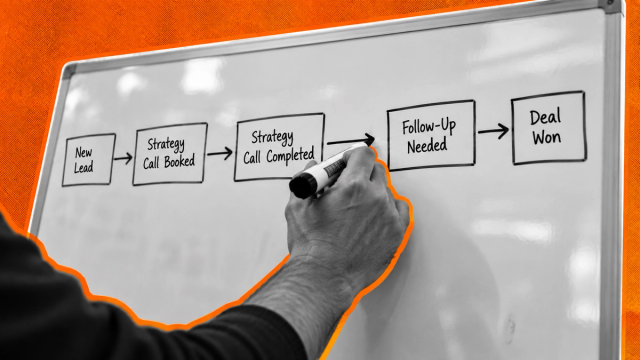

I spent about 2 years in corporate sales and generated roughly $1M CAD for that company. Everything was manual, so I started testing tools like Apollo and FullEnrich with my own money.
On May 15, 2025, I left the corporate world with 1 small client and ran with it. Since then, I've worked with 18 clients and built Coda Outbound to roughly $20K a month.
These 13 rules are how I turn cold calls into real conversations, and how I turn those conversations into pipeline for my clients.
1. Get stubborn about your ICP.
Pick 1 job title, 1 industry, and 1 region. That's it. When you're calling the same type of person with the same problems, you know the script like the back of your hand. You stop reading and start focusing on the conversation.
2. The opener doesn't matter.
I've said, "Hey, what's up?" I've said, "Hey, what's good?" I've said, "Could I take 20 seconds of your time?" There's a person on the other end. Talk to them like one. What matters is what happens after the opener.
3. The next 20 seconds are everything.
Those 20 seconds are where you drive authority and relevance. Why should this person care? What have you seen that connects directly to their business? What problem can you confidently say you understand? Get that right, and you earn the rest of the conversation.
4. Use silence.
Ask the question, then stop talking. Maybe they're processing what you said. Maybe they're reasoning in their head that this could be a good solution. Give them that space. You don't have to fill every second. A good call needs ebb and flow.
5. Fix the list before you fix the caller.
You can be a great cold caller and still look terrible with bad data. I research the companies, score them, verify that the people still work there, and double-check that the mobile numbers are actually mobile numbers. I might cut 20% of a list before I enrich it.
6. Start with 100 to 200 people.
I like to test a niche with 100 to 200 people. I want to dial them Monday to Friday and get through the list at least 5 times that week. That tells us how many attempts it takes to reach somebody, how people respond, and what the market is telling us.
7. Put the prep where you're calling.
My prep is built directly into Close. Anything unique, like a hiring signal, gets pulled into a pinned note at the top of the lead. The note has the script and rebuttals I might need, so I don't have to leave Close or context switch.
8. Get curious instead of arguing.
When somebody pushes back, get curious.
"Oh, you don't want to do this? Okay. I'm sure you guys are okay, but do you want to be great?"
You're questioning their thought process, not fighting with them. Curiosity gives you a better chance of getting to the next step.
9. Confidence starts with research.
If you have a good list and have researched the company properly, pushing back shouldn't feel like pushing back. It should feel like confidence.
"Hey dude, I know what you're struggling with. I'm convinced we could at least show you what to do, and if not, you can tell us to kick rocks."
10. Make the ask low-lift.
Don't make the meeting sound like a massive commitment.
"It sounds like it might make sense for you to have a chat with us. I'd want to put you down for 10 minutes next Tuesday at 3 pm. Does that work?"
If it doesn't, give them 2 options. Make it simple and nonchalant.
11. Stay on the phone until the invite arrives.
This is still one of the most common misses I make. Once they agree to the meeting, stay on the phone while you book it. If they don't get the invite while you're there, it's hard to confirm they received it. Don't lose the meeting in the final 30 seconds.
12. Look away now. Listen back later.
Once I know who answered, I stop staring at the screen. I stand up, walk around, and focus on the person. Afterward, I listen back to my calls. I cringe listening to myself, but it helps me hear what was bad and work toward a new goal.
13. Track conversations, emails out, and emails in.
There are 3 metrics I look at: conversations, emails out, and emails in. If I have 10 conversations, I should see 10 emails out. If 1 or 2 people reply, that's a great day.
Even with 0 replies, 10 conversations can give you 10 unique pieces of intel for next time.
Cold calling is 10 times harder than people think. There are days when nobody answers. There are days when you're on a dry spell and can't get a conversation or meeting.
But people are people. It doesn't matter how much you prepare for a call—if you don't know how to talk like a human, none of it matters.
For me, Close removes the thinking around what to do next. I click down to the next Smart View, and I can call across 5 clients without thinking. The CRM keeps me moving. The playbook is what makes the conversations work.