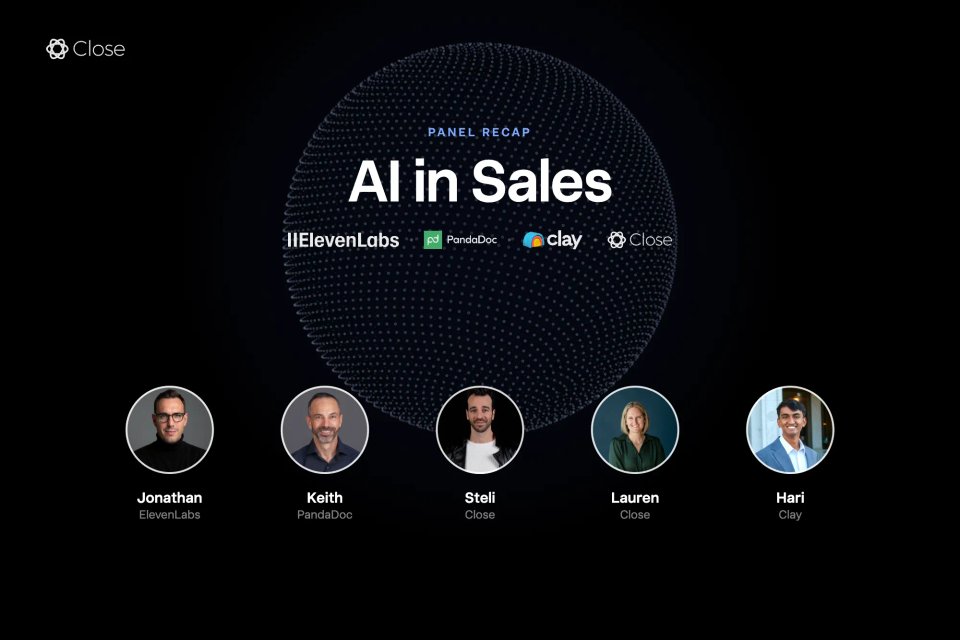


A recap of Close's live panel with leaders from ElevenLabs, Clay, and PandaDoc. You can watch the full recording here. Or if you'd rather read the highlights, here's what came out of the conversation.
When Lauren Schuman, VP of Growth at Close, opened the panel by asking each speaker for a single word to describe where AI in sales is right now, she got four very different answers.
Steli Efti, CEO of Close: "Dangerous." Keith Rabkin, CEO of PandaDoc: "Promising." Jonathan Chemouny, Sales Development at ElevenLabs: "Transformative." Hari Kumar from Clay: "Misunderstood."
That range captures the current state of the conversation. Depending on where you sit, AI in sales is either an urgent opportunity, a minefield, or something most teams still haven't figured out how to talk about honestly.
Here's what an hour of real conversation actually surfaced.
The Two Failure Patterns Nobody Talks About
Steli's "dangerous" framing wasn't pessimism. It was a diagnosis.
"I see two patterns, especially with smaller teams," he said. "Either it's head in the sand — they played around, got burned enough times, the demo was exciting but then nothing works as promised — or they're trying to build a thousand agents orchestrating their sales efforts and they just can't make anything work."
Both paths lead to the same place: opting out.
"By the time you wake up and everybody's figured everything out, you are out of the market, out of business, and out of a job."
The teams doing it right, he said, take a five-year view instead of a binary one. They push through the dead ends, find the pockets that work, and keep going. Keith added another dimension: buyers are getting smarter faster than most sellers realize. "AI is raising the game for what buyers expect. It's now much easier to do research at a level of granularity that didn't exist before. I enter the buying conversation much more sophisticated."
Even if AI never touches your sales process, it's already changing the people you're selling to.
Where AI is Delivering Value Today (It's Not Where Most People Look)
The instinct for most teams is to reach for AI to do more — more emails, more calls, more sequences. The panel pushed back on this pretty consistently.
The context engine, not the script generator
Keith described PandaDoc's most useful internal deployment: a tool that sits on top of their CRM and pulls data from product usage and customer telemetry into a single view. "That's really helpful whether you're prospecting, doing renewals, or doing expansion, because you can understand the full picture."
Hari from Clay framed it similarly: "Going into that call, getting a brief of not only your first-party data — touch points, transcripts, deal state — but also third-party signals. Where is their intent coming from? Are there challenges their company is already going through that you can reference? That allows your SDRs to be a lot more empathetic on a call and develop a connection that otherwise would have taken an hour."
Smarter signals, not more volume
"When people think about AI and sales, they always think about automation," Hari said. "But where I see the most interesting applications is in getting more custom buying signals and actually understanding when to reach out. In the past, you'd go off revenue, basic firmographics. In the new world, you can see what a CRO is posting about, what content they're engaging with. You can have a more human connection, and we generally see that improves close rates."
The buyer experience lens
Steli made a point that kept coming back throughout the conversation: most salespeople are asking the wrong question about AI. "Too often we ask: how can AI make my life easier? What we ask too little is: how is this making the experience better for somebody who has to receive an email from me, get a text, see a demo, buy the product? You want AI to make your buyer's life better, not just make your life easier."
The signal that it's working, he said, is when a buyer says "that email was incredible — how did you do that?" or "that thing you showed me in the demo was magical." That's the difference between using AI to create more activity and using it to create a better buying experience.
The Personalization Trap
Multiple speakers flagged the same failure mode: AI personalization that's technically personalized but feels wrong.
"I get AI-generated outreach every day as a CEO," Keith said. "Automatic deletes. You can see the M-dash from a mile away. The language reads like AI. Just being cautious that you're very natural about it is important."
Jonathan echoed it from the other side as someone whose team experiments aggressively. He tried sending AI-generated personalized videos to prospects, with custom backgrounds and tailored messaging. "It didn't work at all. It was weird. Cool doesn't always convert."
The line, as the panel described it: personalization that feels native to the buyer's world is good. Personalization that reads as uncanny, hyper-specific references, LLM cadence, the M-dash all actively damage trust.
When AI Improves the Experience: What Happens When You Get It Right
Steli shared the most detailed example of the conversation: Close's own deployment of Chloe, a voice AI agent built in partnership with ElevenLabs that calls new trial signups immediately.
The problem it solved: small sales teams can't call everyone. When a webinar drives a spike in signups, you make hard choices — the big opportunities get human calls, the small ones don't get called at all. "You're giving them a suboptimal experience even though they raised their hand and said I need somebody to talk to me about this product."
Chloe calls everyone. And she starts with full disclosure: "Hey, just so you know, I'm an AI from Close. I'm calling to welcome you to your trial and ask what you're looking for."
"First you can hear the person being turned off. 'You're a voice AI.' They're thinking, when should I hang up? And then... because we spent almost a year perfecting the model for these use cases, Chloe asks very commanding, elegant, relevant questions, questions just too good not to answer. And by the next question, you can literally hear people let down their guard. It stops mattering whether it's a voice AI or not. It just becomes: this is useful. This is a valuable conversation."
One signal that the experience is working: many calls end with prospects asking "Can I use you for my business? Is this a feature in Close?"
Jonathan's team ran a similar playbook at ElevenLabs — AI agents handling inbound in multiple languages (Polish, French, and others) when the team was too small to cover them with reps. "Suddenly we were able to engage with all the leads in real time, but also in their own languages. 80% of the world doesn't speak English." The results: roughly 90% qualification accuracy, 100% accuracy on disqualification. "When our agent decides it's not a fit, it's always right. That frees our reps to focus on outbound and building real relationships."
In both cases, the value wasn't that AI replaced salespeople. It was that AI allowed teams to respond to every interested buyer instead of only the ones they had capacity to reach.
Using AI as a Critical Friend on Your Pipeline
Keith offered a less obvious use case that often gets overlooked in conversations about AI and sales: using it to pressure-test your deals.
"Having your AI be really critical about your pipeline and understanding what your objections are, what has historically led to closed-won versus closed-lost — can be a really helpful tool. For a small team, understanding which deals you actually have a chance of closing means you know when you need to go generate more. And if you're a manager, being able to ask tough questions of your reps and call BS on shadow pipeline, that's very tangible, and very different from the way we usually talk about AI in sales, which is just 'get me a great email follow-up.'"
What Didn't Work: The Most Useful Part of the Conversation
The panel's failure stories were more instructive than most of the success ones.
Jonathan's AI video experiment: He created AI-personalized videos with custom backgrounds, prospect-specific references, the works. "I thought it was going to work. So I started sending them. They didn't work at all. It was weird." The lesson: technically impressive doesn’t always translate into buyer value. Impressive ≠ effective.
Hyper-personalized sequences that felt "not me" Jonathan also described trying to automate and customize outbound sequences. "I was reading the messages and it was just... not me. It's so weird." His conclusion: sometimes writing something yourself, quickly, with imperfections, works better than a polished AI version. "At least there's no M-dash."
Sprinkled AI features that don't go deep enough Steli was candid about product mistakes at Close: "Some of the things we released were the type I hated — here's an email thread with three emails, but there's a little sparkle that says 'summarize the email.' That's stupid. I don't need a summary that's going to be longer than the email itself." The learning: go deep on fewer things, don't sprinkle AI everywhere and call it a feature.
Trusting AI summaries without checking Steli described catching hallucinations in call summaries, plausible-sounding quotes attributed to prospects who never said them. "It completely changes what the buying signal is. It happens here and there. So you have to double check. You have to lean in and look at things in a detailed way." The practical rule: use AI as an assistant, not a source of truth.
Trying to one-shot years of product craftsmanship Keith made a broader point about teams trying to replicate with AI what software companies have spent years building. "People are trying to replace tools and build their own enrichment, their own agents. It's brittle. As your prompt changes, as token costs change, as security and privacy requirements change maintaining that can cost more than just using the software that exists. That craftsmanship element is really salient."
One More Warning: AI Is Changing How People Write
Steli flagged something more subtle that doesn't get talked about much.
"I noticed with a couple of people in the company, salespeople included, they were using AI so much, going back and forth with it, reading it, that they started writing to me in a tone where I'd have to ask: is this AI-generated? And they'd say, I promise, I actually wrote this."
The risk is drift — your natural voice slowly converging toward LLM cadence because that's what you've been reading and producing. His advice: keep a writing and speaking practice that's separate from AI. "If you're in the business of connecting with people, convincing people then you want to retain your ability to communicate in ways that are your unique style, your charm, your way of talking. That's what makes people trust you."
The Practical Playbook: Start Here, Ignore That
If you're running a small sales team and haven't gotten started with AI yet, the panel converged on some clear guidance.
Start with prioritization, not scale
"We see the most leverage out of prioritization use cases," Hari said. "When you're a small team, understanding who to reach out to, why, and when — those are your three biggest levers. That's the playbook that worked at Clay when we were first growing, and what we see work for our SMB clients."
What to ignore for now: "AI outbound at scale. Scaling actually unscalable systems. You might test an email on 10 customers and it goes great. Apply it to 100,000 and you'll find a lot of gaps."
Write down your deal truths first
Keith's starting point: before you touch a tool, write down what makes a successful deal, what makes a bad deal, what rules you want in place, what playbooks you want to run. "You can do that before you even start implementing. Then have your AI help you prioritize and enforce those."
Fish in your local lake
"A lot of customers try all the playbooks they see from their favorite LinkedIn influencers from webinars like this, without first understanding who they're really good at selling to," Keith said. "They try to go after the entire ocean when they should be fishing in their local lake."
Never fully outsource customer contact
Steli closed with a principle worth repeating: keep doing some unscalable customer work, even when your AI is working. "Do a call with prospects every month. Same thing with email. Same thing with every part of the selling experience. Not because it's necessary, but because it gives you new ideas. That customer intimacy is what sparks new ideas, and those ideas go back into the agents and the automation you're building. Never fully outsource that, no matter how well it works."
The Bottom Line
AI doesn't remove the need for sales. It raises the bar for what good sales looks like.
The teams getting leverage aren't the ones doing the most with AI — they're the ones who've figured out where human judgment still matters and where AI genuinely extends it. Better context before calls. Smarter signals on who to reach out to and when. Faster proposal-to-signature. More honest pipeline review. A voice agent that handles the follow-ups your team can't.
The human handshake at the end of a deal isn't going anywhere. The question is how you get there faster, with a buyer who feels like you actually understood them.
You can watch the full panel recording here or read the full transcript. The conversation goes deeper than any recap can.
This post is a recap of "AI in Sales: What's Actually Changing (and What Isn't)," a live panel hosted by Close on June 10, 2026, featuring Steli Efti (Close), Keith Rabkin (PandaDoc), Jonathan Chemouny (ElevenLabs), and Hari (Clay), moderated by Lauren Schuman (Close).