AI in Sales - Live Panel

Runtime: 
59
 minutes

What's working, what isn't, and where to start — a ground-level panel on AI in sales with practitioners from ElevenLabs, Clay, and PandaDoc.

​[00:00:00]

All right. Well, hello. Hello, everybody, and welcome. Uh, I am Lauren Schumann, VP of Product Growth here at Close, and I'm very happy to be here moderating this great panel and discussion today. Uh, we put this panel together because we kept hearing sort of the same thing from sales leaders and founders that there is a whole bunch of noise in AI, and sales is no exception to that, and there's just not nearly enough sort of honest conversation about what's actually happening on the ground.

So today, that's what we'll be talking about. We're here to talk about what's working well, what's not working well. We have just an hour. We've got four great panelists joining us today. I'll try to make room for questions at the end, so we'll be monitoring the chat. Feel free to drop in any questions that you might [00:01:00] have along the way.

But with that, we're gonna jump in and do some quick introductions, and then we'll get to the meat of it. So if you would just tell us a little bit who you are, and I'm gonna challenge everybody with one, a one-word answer of where you think AI in sales is right now. With that, Steli, would you mind kicking us off, please?

Thanks. Yeah. My name is Steli Efti. I'm, uh, the co-founder and CEO of close.com. Uh, I've been in sales my entire life. My first job at 16 was a appointment setter for a realtor, uh, doing cold calls. Um, grew up and born in Germany, uh, moved to the Bay Area when I was 20 and lived there for 20 years. Uh, and then final since was in New York and Austin.

I'm currently in Greece. Uh, and so super psyched to chat with all of you about AI in sales, and I'll say my one word for where, where AI is in sales today is gonna be [00:02:00] dangerous

Dangerous. I like it. Starting off on a, a hot, uh, note. Keith, how about you? Hey, I'm Keith Rabkin. I'm the CEO of PandaDoc. PandaDoc is an agreement platform. We help companies, particularly those that have a CRM in place, generate contracts and sales proposals with a beautiful template. Um, previous to this, I was the CRO here, so I do know a thing or two about sales, and I would say the one word that I would give is promising

I love the juxtaposition there. Uh, this is gonna be a good one. Jonathan, how about you? Uh, first of all, thank you so much for, uh, for having me today. So my name is Jonathan Chamony. I lead sales development at ElevenLabs. If you don't know ElevenLabs, it's an AI company. We build [00:03:00] industry-leading AI voice and audio models, and we deliver those in a platform that can power every interaction, so from, uh, sales to support agents, business operations, creative tools.

Um, my one word will be transform- transformative

All right. Transformative, I love that. Um, Hari, how about you, uh, take us home? Yeah, definitely. Um, I'm Hari. I, uh, work at Clay, which is a data enrichment platform and orchestration platform on the product team. Born and raised in Jersey, but live in, in New York City now, um, after doing a, a brief stint in the Bay where I was doing a ton of contract consulting, so a lot of, uh, manual outbound.

I wish I had a, a tool like Clay, uh, at that time. If I had to think about the state of AI today, I would ... In, in sales, I would say misunderstood Ooh, I love that segue. Well, let's start then with a reality check. So [00:04:00] when you all look at how small teams are actually using AI t- AI today, small sales teams, not just like the demos that we all see, they look great, right?

You get this promise of what might be possible, but what does it look like in real life? What's the honest picture of what you're seeing?

I'm happy to go first. Um, at PandaDoc, we're using AI pretty aggressively in sales, but I think one of the things we're very thoughtful about is, one, making sure we don't put slop into what we're doing, and two, that it adds real value. There's a lot you can do with AI, but it's stuff that, you know, might be a truly marginal improvement versus the cost you're spending on the token.

And so we try to really think through where we add value. One of the things we did that I, I think is pretty useful is we created a new tool that sits on top of our CRM and pulls the data from there and from [00:05:00] our product usage, and then gives our teams a single pane of glass to look at a 360 view of our customer.

And that's really helpful whether you're prospecting or doing renewals or doing expansion, because you can understand telemetry across multiple data sets, and I think that's where AI is really strong. We've also been using it more on the customer-facing side in a way that I think provides tremendous value on the, the close rate front, which is when you go into a demo, making sure that demo is highly customized to the customer.

Instead of doing your generic demo, the speed with which you can customize based on what you know about the customer, their specific use case, can be highly tailored, and I think anytime you can speak in the language that is really native to that customer, it provides value. Things where we're, we're not spending a lot of time is, you know, injecting AI into, you know, highly customized, tailored outbound.

I get those [00:06:00] every day as a CEO, and they're automatic deletes because they are just... They're not thoughtful. You can see the M-dash a mile away. Um, the language reads like AI. You know, the, the classic giveaways like, "Can I..." You know, like, the questions they finish up with. So I think just being cautious that you're very natural about it and thinking through that true value add on is important.

Yeah, I can kind of add onto that and very much resonate with the point that I think when people look at, like, AI in sales, they always think about that, like, email automatic, but it's actually, like, not resonating across the board because you can just see, like, an MDASH from a mile away, where I think the mo- most interesting applications that I'm seeing and, and kind of a growing trend is with getting more custom buying signals.

So actually understanding, like, when to reach out or qualifying in a more unique way. I think in, like, the past world you can go off things like, you know, revenue, basic firmographics, but in the new world you can actually see, okay, like the CRO, for example, what is he posting [00:07:00] about on, you know, his professional platforms?

What kind of content is he engaging in? Uh, and by way of giving that to your reps, you can then have a more human connection that we generally see, like, improves close rates across the board.

Yeah. And, um, I would, I mean, totally align with, with what you said. I would say what is, what is super interesting at the moment is, to be honest, there is a lot of BS about, about AI. Many companies are, you know, telling you, "Oh, yes, we can, we can replace the sales team with AI." We, we all know that. It's everywhere on LinkedIn.

Um, so personal opinion, it's, it's not magic AI, but what I think is, and it's very true for small teams, it can be a game changer. Um, because with, you know, for example, using Clay, uh, using, I don't know, uh, Claude and, and, and so on, you can, you can do something that in the past you had to be a really big team just to, to do the same.

So me, I'm super excited about that, and, and if... I mean, I can share more examples later about what we did at Eleven up- Eleven Labs, because [00:08:00] the team is growing, but when I joined Eleven Labs, it was very small teams, and we were able to do amazing things just being a small teams, but leveraging, uh, correctly, uh, correctly AI.

And something also is when I joined Eleven Labs, for example, I, I thought that, yes, I know what is AI, you know, I know to use ChatGPT and blah, blah, blah. I knew absolutely nothing. I knew absolutely nothing. And the companies that will be successful is having the right people being AI fluent, knowing everything about AI.

It will make their company very successful in the future Awesome. Yeah, good stuff. Uh, let me go last and round us up on this question. So the reason I use dangerous is because I, I see two patterns, uh, especially with smaller teams. Either it sort of head in the sand, like they played around, they got burned enough times where the demo was exciting, but then you try to sign up for the product and either the sign up doesn't work or you're in the product and just nothing works the way it's promised.

Or they're trying to build an agent because everybody is 1,000 agents [00:09:00] already orchestrating their up on sales efforts and they just can't make anything work. And, uh, they go back to not being interested, right? They're just like, "This is overwhelming. Every day there's a news. This week everybody's excited about A, next week everybody's saying A is stupid, you need to do B."

And so what most smaller teams, uh, that are not working in AI and tech d- do that I observe is that they just decided to opt out until the market has settled what is really going on. So they're not even looking into it. They seem oftentimes shockingly uninterested or uncurious. And then, uh, and that seems dangerous to me.

Like, you just can't ignore this just because it's changing, just because there's maybe overpromising going on. And then there's the other side of it, which is some, some of them decide to sort of push through the discomfort, through the changes, through some of the dead ends and find the pockets that work and make them work for them and get better and better at this.

And they take a very sort of like, this is gonna be a five-year journey approach versus is AI gonna transform my [00:10:00] business tomorrow? Yes or no, it's a binary thing. And if it's no, then I'll just ignore it and ignore everything about it. That seems very, very dangerous, right? Like, the- you can't ignore everything that's going on.

By the time you wake up and everybody has figured out everything, uh, you are out of the market and out of business and out of a job. So then it's too late to, to get back into it. So, um, but, but th- th- those are the really, the, the two areas. There's a small amount of people that are incredibly curious, they're leaning in, they're trying to make things work every single day, and they're not as easily discouraged about what's not working.

And ideally we can all contribute to making everybody in this webinar join that group, right? And help each other in that group because I think that group will have a much better time in the future and is gonna be able to provide a lot more value to their customers and, and all the efforts they're involved in.

Kelly, you made me think of one other thing, which is, like, in the realm of dangerous, but it's dangerous in the sense for everybody, which is... Or I guess dangerous in the sense for sellers, in that AI is raising the [00:11:00] game for what buyers expect. Because they're gonna do some re- Like, now it's much easier to do research at a level of granularity that didn't exist before.

So as I'm comparing tools or products and I'm shopping, I can now have agents or my LLM go and do this research for me and get me feedback across a vast array of information that, that was really hard to get to before. And so I enter the buying conversation much more sophisticated, and I think that's, that's dangerous, but also an opportunity for sellers if they know how to take advantage of it.

That's a wonderful tee up. I think there is definitely a shift in expectations. I know I went through recently process evaluating a whole bunch of different vendors, and I saw just such a wide variety of experiences in, in the level of personalization in the conversations. And it was, like, a non-starter to not have done and used some of the [00:12:00] tools to have those effective conversations, and it actually really did influence my point of view on the individual products.

But there's just so much noise about how AI is transforming sales and, um, what, you know, what the average consumer expects AI to do versus what it actually does well today. So I'd love to hear a little bit about sort of that, what you're seeing as the gap between what people expect it to do and what actually the capabilities are that exists now.

I can actually help. Ah, there you go. We all, we're all waiting for the exact same moment. I'll step back. Jonathan or Har, you guys go first. Okay. Um, no, it, it, you know, it, it's super interesting because 11 labs, we, we, we created an AI agents platform. And you could think that we, we think that it's going to replace everything.

I think it works well for some use cases. So me, I lead sales development, so I think for inbound [00:13:00] calls when we have contacts, it works really well. It's amazing. And every day I'm impressed by, you know, the conversation that our prospects are having with, with the AI. But let's consider no cold calling and, you know, everywhere on LinkedIn you can see that can do cold calling incredibly well, blah, blah, blah.

You, if you take your best, uh, SDR, BDR, they're going to struggle sometimes with cold calling. Myself, struggling all the time. It's difficult, you know? And the thing is saying that AI is going to do cold calling like, you know, the best in the world, I'm not sure we are there yet. I'm not saying that it's not coming.

Probably it will come, but I think that today we are not at, at this level. It's also important to be, to be clear on what we can do today and what is impossible today. And yeah, it's also being responsible with AI

Yeah, I'll jump right in. Ah. Go ahead. Go ahead. We, we have impeccable timing. We either don't speak, or we speak, [00:14:00] uh, decide to speak at the exact same moment. I like it. All right, we'll get into it. Hari, you go, obviously, uh, next, and then I'll follow. Oh, sure. Um, yeah, I- I think, like, where I see, like, the, the highest leverage or, or where AI's, like, most ignored, where I think it does really well is in the data aggregation piece of it.

So you can imagine you have a platform like your CRM, whether you're using something like Close, whether you're using Clay. When you're going into that first call or going into that cold call, I think it's, like, very important to have all the context in front of you. And so where I see AI helping small teams especially really 10X their leverage is going into that call, getting a brief of not only all your first party data, what are the touch points you've had in the past, what are those transcripts from your meeting note taker, what is the current state of the deal, but then also those third party signals where you can understand more about a person.

Where are they currently at? Where is their intent coming from? Are there any challenges their company is already going through that you can reference? And so to, to the point in the chat about empathy, [00:15:00] Jonathan, that you mentioned, I think that allows your SDRs or, or your BDRs to be a lot more empathetic on a call and develop a connection that otherwise would've taken an hour of prep.

Awesome. Um, so There's a couple of thoughts that I have. When it comes to, to AI, I think some of the things are obviously great, right? Like AI is great at data aggregation, at, at doing the kind of like analysis of data that you would need, uh, data scientists and a bunch of people, you could probably do pretty powerfully if you're connected to the right data sources and the, the data is good.

On your own, you can be, you know, lead enrichment, as with Clay, is like on a totally different level today than it's ever been, and so it's a, it's an incredible opportunity. Um, and then there's like signal timing, um, there's other things that can be scaled. But, um, I think ultimately right now, it doesn't matter if you're a seller or anything else, you'll have to assume that you have to work, um, a lot more intensely and not less.

So some people they try [00:16:00] to totally replace, um, part of the workflow so that they don't have to do that. The, the, the issue that I see with that is sometimes, um, that level of laziness, uh, and maybe that level of not having really deep understanding of a certain area or not utilizing your particular point of view or your particular background of having deep expertise somewhere, not utilizing that and just taking the out of the box, whatever the agent will do or whatever the, the model would do for you, is putting you at a disadvantage because you're not gonna differentiate yourself, you're not really gonna, um, at, at times notice when something is, is off, right?

I challenge a lot of our leaders in the company to be ping-ponging these days. Like you can't be just high level asking Claude all questions and then giving me the beautiful reports that Claude puts up. You have to double-check some of these things because it sometimes, a hallucination sneaks in all kinds of little places.

And so I, you know, I'll ask Claude something about how s- a certain call went with a prospect. It'll give me an incredible summary [00:17:00] that sounds so plausible and impau- like really, really great. And then I'll double-check and listen to the call recording. I'll hop into that point where Claude says, the prospect says this exact sentence, and then the prospect doesn't say that.

I- isn't saying that sentence, right? But it's so plausible that he would have or she would have said that sentence, but it's not there, right? And it changes completely what the buying signal is or isn't or what happened in the conversation. Sometimes it doesn't happen. But it happens here and there, so you have to sort of double-check, you have to lean in and, and look at things in, in a detailed way.

And I think ultimately you need to pour into your expertise and sort of connect it to what you're getting from AI to really stand out, to differentiate, and to have a double punch versus sort of, um, you know, taking all responsibility off and say, "I'm just gonna have the agent do everything, and then this problem is solved, we're off to doing something different."

Even if it does work today well, you have to check in next week, is it still working well? And you have to take one perspective, I'll finish with that and I'll give it over to Keith, [00:18:00] that I think has always been important, always been in short supply, and with AI it's even a bigger issue, especially in sales, which is taking the buyer's perspective, right?

Way too often- We just think, "What's cool? We could double the amount of calls we're making. We could, uh, customize all our email outreach. We could get better dashboards." That's all me, me, me, us, us, us. What could we as a company or salespeople get? What we do too little is the translation of what is in it for the buyer, for the prospect?

How is that making the experience for somebody better that has to read an email from me, or get an email from me, or get a text message, or see a demo from me, or get a follow-up from me, or try to get, uh, the product bought? How is that experience getting better, faster, smoother, more impactful, more valuable?

We're not ... oftentimes, I see salespeople don't ask that question, "How can I use AI to make my buyer's life better?" Versus, "How can I use AI to make my life either easier or add more cool shit to how I do [00:19:00] selling?" Right? Um, which, which can be nice. Like, you should have that perspective, but really you need to lean into the buyer experience, the prospect experience and see where can I wow people.

And the signal is your buyers and your prospects are saying, "That email was incredible" or, "That thing you showed me in the demo, how the hell did you do this? That was magical." And then you could know that's because of AI, right? Like, I used this cool thing agent to create that experience for the buyer and wow them and make that really, really appealing, um, instead of just looking at like what all the things I could use and I might want to use as a salesperson, um, because oftentimes it might not translate at all to something that makes your buyer lives better, and ultimately they're not gonna be buying because of it.

Um, yeah. I think that's really well said on the buyer perspective. And, you know, I think a lot of what Jonathan and Hari were talking about of some of the things AI does really well lead to great buyer experiences. You know, the collection of data, as Hari said, and that, like, omni view of a customer leads to a great buying experience.

I think the other piece, and, [00:20:00] you know, it's something we've really thought about how to deploy AI most effectively, is customer education, particularly early in the buying process, whether it's a chatbot on the website or a voice agent that can answer customer questions, that is something it does really well because you've usually got a, like a very dedicated set of knowledge that's feeding in, and you allow the customer to sort of educate it.

So it, it's taking what I said was that danger before of a customer coming in educating and, and shaping it in a way that it helps them get comfortable with your product I think the piece where AI can be dangerous is not providing enough context. So that's a great example of giving it the context it needs to answer questions.

If you say all of us are using AI to sell to a customer, and we all know the same thing about a customer, and let's just take Close as business or the CRM, the danger is that it just, like, reads Close's list and says, "Hey, this is the [00:21:00] perfect solution for X customer because of X, Y, and Z," without understanding what is really unique and special about your software and that particular customer, or the kind of business outcomes you want.

Like, what should your discounting rate be? What is an acceptable rate? Um, that business context that ties into your financials and your go-to-market motion, your cost of sales, and understanding it to make sure that the AI directs in the right way is really important and often a forgotten piece while we try to, you know, just get the customer hooked on something that looks great Some really great insights shared, I think, across all parts of selling.

I'd love to get a little bit more specific, uh, and talk about sort of one part of the sales process where you've specifically seen AI create a real and measurable advantage for small, um, [00:22:00] sales teams. I think we've talked a lot in general about AI and being able to measure the impact. There's a lot around time saving and productivity, but I think there's also a big debate around driving actual outcomes that are measurable.

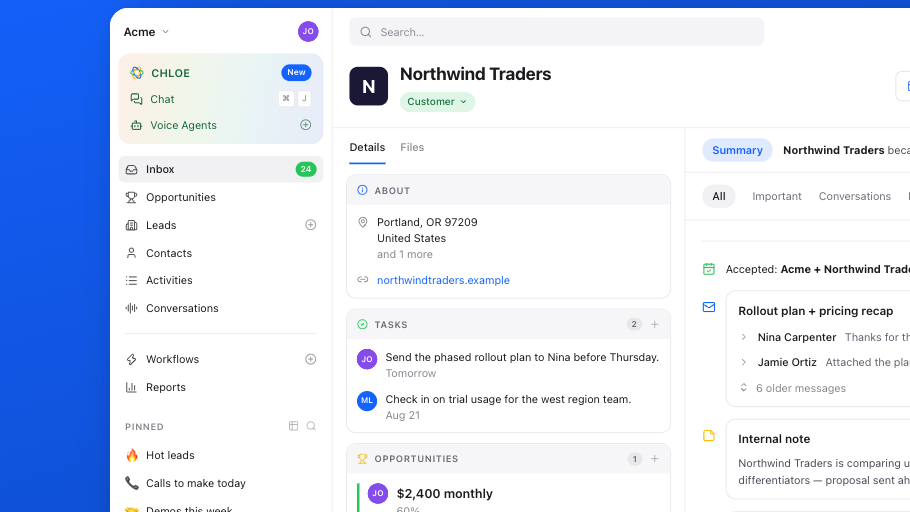
And so I'm very curious your take on where you can really measure that advantage for small sales teams Uh, I'll start on this one, um, because, and it ties into also some- something somebody in chat talked about, like, are people even wanna talk to AI? Are they turned off by when they, they see it's AI? Um, so i- i- in Close, we're a CRM company, so we have tremendous amount of data in our CRM and for our customers, and we partnered up with Eleven Labs to, um, create a, a native voice agent built in Close called Chloe that takes advantage of having all the contextual information, be able to place calls with prospects and buyers at the right time, the right context.

And so a lot of our, like, for us, as, you know, a, a lot of our customers will use Chloe [00:23:00] to bring down time to lead dramatically because they just don't have the amount of sales reps always available to call a lead when they just fill out a, a, a Talk to Us form or demo form, or they just sign up for, for a trial, especially as they do sometimes marketing activities that are just, like, um, spiking, right?

They do a, they do a webinar every week. During the webinar, lots and lots of people are signing up, but they can't call everybody very quickly and welcome them to the platform. They can't get in touch with everybody, and maybe they have to make these difficult compromises that we all made where you go, "Well, if it's a really high quality opportunity and a big opportunity, our sales team and SCRs will get in touch.

But if it's, like, a one-seater or a very small opportunity, nobody's gonna talk to this person, even if they raise their hand and they go, 'I need somebody to talk to me about this product.'" Right? You can't afford it as a business to get in touch, so you're giving them maybe a little bit of a, a suboptimal experience.

And so now with Chloe, everybody that signs up for Close get an, gets an immediate call, right? And I'll tell you all, when we [00:24:00] first started experimenting with voice AI, we were like, "What will buyers think?" Especially if you start the conversation with complete disclosure. So Chloe will start saying, "Hey, you know, Keith, just so you know, I'm an AI, uh, agent with Close.

This is a recorded line, and I'm calling you to welcome you to the trial and ask you, you know, what are you looking for in Close today?" And we're like, "What will people do when the disclosure is right up front," right? "Hey, I'm actually a voice AI." And the pattern that I've observed again and again and again is that first you can hear the person being turned off by this, like, "Ah, you're a voice AI," right?

And now they're thinking, "Should I hang up now? When should I hang up?" And then because the, we spent tremendous amount of time, like almost a year perfecting the, the model for these kind of use cases, Chloe asks very commanding, elegant, and relevant questions, right? So she'll ask questions just too good not to answer in the moment.

So they'll, you'll hear the prospect [00:25:00] reluctantly continue the conversation and answer the first question. Because, like, "Uh, I don't want to, but this is a very good question, so let me answer it." And by the next question, you can hear people just let down their guard and go, "Well, screw it. This is good. Like, I don't ca-," like you can literally hear them, they don't care anymore.

It's just like, this is interesting, this is useful, the information is relevant, and it stops mattering is this voice AI or not. It just becomes, this is valuable. This is a useful conversation for me. I like this. And oftentimes because we talk to sellers, the conversation ends with, "Can I also use you for my business?"

Like, "Is this a feature in Close? Can I, like, how, how can I make you make the calls for my business moving forward," right? So we've, we've, we're looking into this, and we're curious very early on, and what we've seen is that if you work hard enough to sort of make the model good and make the agent really, really good, and if you give it contextually the right information, if you call at the right time, [00:26:00] right?

It's the right time with the right context, then for many people, they will start skeptical, but eventually they'll decide it doesn't matter. Like, this is useful, so I'm interested in this. Um, so that's been something that we've seen and that has really empowered a very tiny sales team to be able to all of a sudden get a lot more leverage, uh, and be able to provide a lot more value to a lot more people I, I would go away, I, uh...

Sorry, um, go ahead No, no. Go, go ahead, Chris I, I was going to say, a lot of times when you talk about AI, you think about the customer interaction, and I think that's really useful. Another place, and it ties to one of the questions, um, what is a competitive advantage? I think for small teams of sellers, having your AI be really critical about your pipeline and your deals and understand what are your objections can be a really helpful tool for you.

Um, and again, you can give it context on what has led to successful closed won in the [00:27:00] past and what has led to closed loss, or what has led to late-stage pipeline falling out. That kind of context can be really useful, as a seller understanding which deals I actually have a chance of closing, which means if I don't have enough to hit my goal, then I've got to go back and generate more pipeline, and I think that can be really useful.

And then also, if you're a manager of a small team, the same thing. You know, have it be really critical. It's really hard to, to scale across, you know, 30 deals a month or 100 deals a quarter. Having the AI, again, with the context of what makes good deals and the historic context be that, that tool that helps you deep dive and ask tough questions of your reps and really call BS on what a shadow pipeline or what has no chance of closing is a really useful and tangible skill that's very different from how we talk about it a lot, which is just like, "Get me a great deck, get me a great email follow-up."

[00:28:00] Um, so I like using it in that way Just to, to, to share some, some numbers on, on this or so, uh, and just your initial question around about, about the, the small team, because I think it's, it's, uh, it's super interesting also for, for the audience. Um, quick story. At Eleven Labs, back in June last year, we, we released a new model, V3, super text-to-speech model.

Amazing. Suddenly, we had a peak of inbound, uh, contacts. And me at this time, I had a very small team, and I was leading Europe. Imagine, uh, many people contacting me in different languages. I had only three reps speaking only Polish, French, me, and, um, and I think that's it, and English. So it was very complicated for us.

So we started to roll out, um, Eleven Labs agents, AI, similar to the one, uh, as Chloe. And it was a game changer for us because suddenly we were able to engage with all the leads in real [00:29:00] time, but also in their own languages, which makes a difference because you know that 80% of the world, they don't speak English.

So it was, it was a, a game changer. And in terms of number, as today, we are about 90% of accuracy in qualification when we, when we engage with a, with a lead. We have some false positive because, you know, our agent is sometimes too optimistic. Uh, and in terms of disqualification, we are at 100% accuracy. So usually when we have the conversation and we know that it's not good, AI SDR is always, always right.

And for us it's a game changer because when AI SDR can do that, then our reps can focus on outbound. And I saw a question on the, on the chat about we, you know, building relationship is super important in sales, and this is it. So because we have more time now, our reps can do better outbound, can go, uh, face-to-face meeting, meeting the prospect.

And it's, it's also a new way. That's why, you know, my first wor- word wa- was transformative because I think the, the role of SDR in sales, instead of staying behind the screen and sending stupid emails, we all know that, [00:30:00] it will be more about bringing value, giving value to the prospect, expanding what we can do with AI, in the case of Eleven Labs, and, and this is how we are going to close better deals and also bigger deals Yeah, I love that concept.

I think there's a risk of AI simply making sales seems faster, but not actually better. So the... It could be more activity, more follow-ups, but like, they're actually worse follow-ups. And I think, Jonathan, that was a great example of how you all are employing techniques to guard against that. But I'm curious from the others, what are things that you're doing to ensure that it isn't just like a, "Okay, we're doing faster, we're doing more," but it's actually we're doing more of the right things and it's actually turning into something valuable?

Yeah. I think the, the first thing I can speak to here, and what we see in customers also what our own sales folks do, is, like, I think we still prioritize having a human in the loop at a, a lot of critical touch points. For example, like, we're never gonna have an AI written email [00:31:00] just automatically go out.

Um, we'll use, you know, a Slack approval workflow or something like that, so there is a, a manual review process. Then I think the other thing that's, that's kind of a guardrail is we have agents that have the context of what's going on in the relationship. So let's say on the last call, one of our sales reps verbally committed to sending over a pitch deck, and then three days later they've forgotten about it.

In, in a pre-AI world, like, that lead is probably dead. Um, in the AI world though, you ha- you can have an agent that at the top of every morning tells you exactly what you owe your customers and remind you throughout the day. And so I think those two touch points are, are kind of guardrails to relationships that we see a lot.

Um, the other thing is, I think in all of the workflows that we generally build, we won't just trust the AI for what it's worth. We'll usually input data from reputable sources. For example, for financial data, we might take that from public registries as well as Crunchbase, as well as what an agent thinks, and ultimately make a decision based off all those data points rather than just trusting the [00:32:00] non-deterministic one

Keith, let's, um, chat a little bit about PandaDoc. So I think PandaDoc's a little bit different than some of the folks here in that it sits close to the end of the process for some of the, you know, uh, sales process. How is AI changing what happens from sort of that proposal to the signed deal specifically for smaller teams?

What are you seeing as being like really the, the difference in outcomes? Yeah, you know what's really interesting, um, we've been thinking a lot about where we sit with the changing landscape, and what is fundamentally important at the end of a sales deal is the handshake between a customer and a vendor.

It is this uniquely human moment in an era of AI where two parties commit to doing business with each other. And that is something I don't see being replaced by AI [00:33:00] anytime soon. I- Whether AI can ultimately sell you a tool, it will likely not sign that contract for you anytime in the future, probably because of human trust, but also because of government regulation.

And so we're doing our best to optimize that moment. How do we make the fastest, most intuitive connection between two businesses for a deal to be done? And some of that where we're using AI is to speed up time, make it much faster for you to get to that connection, make it easier for you and the counterparty to say yes, you know, the, the back and forth that sometimes go between, and then the intelligence in the process.

So because PandaDoc is this repository for every sales contract I've ever done, I have unique insight that I can surface before a contract is sent or before a contract is signed telling me, "This is actually good to go," or, "Wow, as a seller, I'm leaving money on the table. The discount that I've put into this contract [00:34:00] is too high."

And sometimes that is hard to get to our close out of your CRM, but that contract is ultimately a document that has unstructured data that historically has been in a CRM and can now be accessed in real time. And so that's where we're evolving the platform to really make sure that our, our sellers, the people using PandaDoc, get as much information to get that deal done and closed as quickly as possible as they can, and then make it easy for buyers to say yes, um, because they understand exactly what the language in the contract says

I think we've shared a lot of great examples of what is working, and hopefully given some specifics to folks that are listening in. I wanna talk about what has not worked. Um, I actually ask this question a lot when I'm interviewing candidates about their experience with AI, and I get all the like, "I did this and I did that," but I wanna know what you tried that did not work.

And [00:35:00] so for you all, what's something you or your customers have tried with AI in sales right now that just, it didn't deliver? It's, it's either not quite there yet or, you know, the technology isn't there. There's something... The em dashes were spotted from a mile away, as is a theme here, but what, what did you learn from it?

Steady. Are you ready to, to reply? I want to do it at the same time. Okay. Three, two, one. Um, okay. I go... You want to go first? No, no, you please. Okay. We, we, we try many things at Eleven Labs. Uh, we love to experiment. It's part of our, of our DNA. And you know, even myself, sometimes I come with a great idea. "Okay, let's do that."

And just two examples. The first one, um, you know, we have an incre- incredible, uh, creative platform, and I love to drop food. So always trying to use Eleven Labs when, when I do something to, to prospect. And I created a video of myself, [00:36:00] an AI video, so it was me speaking, and I was about to customize, you know, the background with the prospect for store, whatever.

It was super cool, and I was, "Ah, yeah, it's going to work." So I started to send these kind of all videos. Didn't work at all. It was, it was weird, you know? So it's also important sometimes to say, "No, it doesn't work." The second example is... And that's, that's something that we see, um, every day. Um, you know, couple of months ago, I was trying to customize and to automate my sequences, um, and I was reading, you know, the messages, and it was, "Whoa, it's not me.

It's so weird." You know? With hyper-personalization, when someone is going to, to tell you, "Hey, you know, I listened your podcast, your podcast in 2017. What you said about this, it was amazing." Come on, it's, it's weird. So I think it's also good to bring some, some human touch on it. And, and also sometimes, you know, when I build something super complicated, the time I spend for building this versus the result, sometime it's, it's faster [00:37:00] to do it myself super quickly, uh, with some mistakes also.

It's not perfect, but at least there is no, uh, M dash and so on. And sometime it works better. So I think finding the right balance also is, um, is a good idea.

Awesome. I'll go next, and then we'll throw it over to Harry maybe, and Keith, uh, is running us up pretty well, uh, so far with m- most rounds. So, and I'll, I'll touch on a couple of things. I'll throw a couple of things in the chat because it's just so compelling. I hear all these debates, discussions. The chat is pretty interesting.

Um, I'll say AI doesn't navigate, uh, uh, voicemail systems well. That is true, but you can do a lot of work to actually make it a lot better. Um, and then somebody asked, and I think you said this, Jonathan, of like, "Hey, some things I decide to do myself," right? It might be faster or better than to let AI do it.

Um, somebody was like, "Uh, by the time I give AI something and a double and quadruple check, I might as just do it faster myself." I... This reminds me very much on, like, any entrepreneur ever hiring their first couple of employees and then going, "By the time I have to explain [00:38:00] everything and double-check and they make mistakes, I'd rather do it myself."

So this is a very... The humans also make mistakes. I tell this to people all the time. Humans sometimes hallucinate, overgeneralize, or delete, forget data. Uh, and, uh, humans are also not consistent in performance, right? Like, so people are like, "Well, this AI agent is not consistent. It did it this way this week and another way the other week."

And it's like, yeah, humans do, do, do that too. Not to say that that ex- that, that means that, uh, you should give AI everything, and it's perfect and just like humans, but I think the framework of how we approach this is important, and you really have to sort of be as forgiving and patient sometime, and creative with AI as you are with humans.

And with humans, I think sometimes we've just gotten used to, to it. But when with AI, we have this sort of expectation that it needs to be perfect in the first go forever, right? Um, I'll say in terms of things that, uh, that, uh, didn't work, I'll go, uh, uh... Should I go this way? Is there maybe some- something better?

My, my, my, [00:39:00] my first approach is just, like, how we actually approach AI as a product, right? Where it was like the first couple of things that we built were very sloppy in some way in my experience. Like, it just... They were good features, but they were just, like, sprinkling AI everywhere throughout the product and, and then realizing, hey, you know, um, this is not really the way we wanna go.

We wanna go really deep. Like, whatever we build should be end-to-end an exceptional experience, and we wanna really think through all the edge cases. And like a craftsman, we wanna like, you know, sh- sharpen the little edges and make the experience really round and beautiful and think really deeply about the use case and really understand it in depth and not just surface level.

Um, and, uh, I think that's... So some of the things that we had released are the, are the type of things that I hated, where it was like, here's an email thread with three emails, but there's a little sparkle that says, "Summarize the email." And you're like, "W- I... This is stupid. I don't need a summary that's gonna be longer than the email itself."

This is just a dumb thing to do. Um, although this is less about, like, how to [00:40:00] sell with AI and make mistakes, it's more about, like, how do we think about building with AI, but, but both things are probably connecting. Um, so My dogs are going crazy. Somebody dares to walk past our fence. I apologize to them and to you.

But I'll stop right here. There's probably a, there's probably a bunch of things that we've done that were, uh, mistakes that could be done, uh, uh, better. I'm sure Keith will have some good examples. Hari, Hari, are you okay if I jump in? I just wanna dovetail off- Yeah ... something Steli said, which is I think that craftsman element is really a, a place where AI can go wrong in the sense that there...

Like, a lot of people are trying to replace tools. We see it at PandaDoc. I'm sure you guys have seen people trying to replace a CRM or build their own enrichment tool. Maybe they're not building their own, you know, voice agents yet, um, or, or voice language model. But I think there's a danger that this craftsmanship that has gone into multiple years of building a solution can be replicated in a one-shot Claude [00:41:00] prompt.

Um, that is very challenging. Yes, you can set up agents that will orchestrate between systems in a very elegant way, but it's brittle, and it is hard to keep moving as all these different things change and as your prompt changes. And the token cost that you have to spend to keep it up and running can oftentimes be more than the software that exists out there.

And let alone, you're not even looking at the under-the-hood things. Like, is the security there? Is the customer privacy there? Um, in our case, does, is there a certificate that would legally be binding in court for the combination of this trust moment? And so I think that craftsmanship element is really salient of something that, yes, AI can do it, it absolutely can, but it requires a lot of work to make it really perfect versus, you know, software solutions that have been built over multiple years.

Um, so I [00:42:00] think that's a really important piece of something that AI can do, but is tough to get right. I- I'll quickly, I'm so sorry, but I'll interject one thing, otherwise I'll forget it and I think it'll be hopefully real useful before I let you, uh, Harry, uh, wrap us up. One thing that I noticed with a couple of, um, people in the company, salespeople included, were that they were using AI so much and going back and forth with AI so much and reading AI so much that they started writing to me in a tone where I would have to ask them, "Is this AI generated?"

And they'd be like, "No, I actually, you know, promise to God I wrote this to you." And they're like, "But, you know, I've been spending, uh, you know, midnight hours burning the midnight oil like till 6:00 AM in the morning, going back and forth with AI." And eventually you get trained in a certain tone and a certain cadence of writing.

Um, and I, what I would advise people to do is to, like, learn to use AI heavily and have it write things, sometimes drafting stuff, it can be so useful, but you wanna keep a writing [00:43:00] practice and a speaking practice, especially if you're in the business of selling, right? If you're in the business of connecting with people, convincing people, you wanna, uh, retain your ability to communicate effectively and you wanna retain your ability to communicate in ways that will be your unique style, your charm, your way of talking, right?

We can't all have a, a charming French accent, but you have your own little thing that will make people trust you and, and love you and like to talk to you, and you wanna keep crafting that, keep working on that, that muscle and not forget that. Because a lot of people probably will atrophy in their ability to write, in their ability to speak convincingly, and, uh, and, and, and that will sort of bring everybody to a common denominator that then gives you the ability to stand out and be better.

So that's maybe a little tip. If you write and read a lot of AI, make sure you still do writing and speaking outside the box of, of AI to sort of maintain your own style. Yeah, and kind of like, I guess a, a little bit different more so from the prospecting enrichment and, and routing angle. I think [00:44:00] the biggest issue that we're seeing, especially with small teams, and the biggest mistakes they're making, is they'll try to fit their one outbound workflow to every type of customer and focus a lot on, okay, what's the AI application here?

How can I add to this prompt to handle XYZ edge case of this new prospect? When actually the more efficient thing to do is to have different workflows for different types of customers and do the routing beforehand. And so when we suggest that to smaller customers, we can see they're not only using different strategies to target those different types of customers, but also their open rates, click-through rates, and conversations are just much better as a result.

A, a more tangible example here is if I have a, an account research flow, for example, and I'm trying to apply that to both, you know, HVAC companies and dentist office, that is probably not gonna be the best research that I could do and enable my SDRs the best. But if I actually split that into two different flows, pull from different data sources, it's much, much more efficient.

So anyone who's leading a, a small sales team or, or might even just be doing the sales yourself, would highly recommend focusing on the inputs [00:45:00] more than just the best prompt or best AI tool. Well, you all have shared some wonderful insights. If I'm sitting in the audience and I'm a part of a small sales team and I maybe just haven't gotten started with AI yet, you are an advisor, you've been hired to help this team.

What's the first thing you would tell them to do? And what's something you would specifically say, you know, you might want to just ignore that for now Yeah, I, I'm going to kick us off here. So I, I think, like, what you should definitely do if you're a small sales team, I think we see the most leverage out of prioritization use cases.

When you're a small sales team, you generally have a ton of leads, whether it's inbound, outbound, your whole TAM. I think understanding who to reach out to, why to reach out to them, and when to reach out to them are probably your three biggest levers in making sure that a small team can have a huge impact.

It's a playbook that we used at, at Clay when we were first growing and, and one we [00:46:00] see all of our S&B clients are really benefiting from. What I would stray away from is trying to increase your leverage by doing things like AI outbound and scaling actually, like, unscalable systems is, is the way I'd phrase it.

Uh, in other words, like, you might have a group of 10 customers that you test this email copy on and it might go great, but then when you apply it to, you know, 100,000 customers, you're gonna find a lot of gaps where it actually just doesn't make sense. Yeah, I would, I would double down on that. Um, what not to do.

Don't try to go big right off the bat. This is, like, a marathon. It's not a sprint. And I think it's important to get started and learning, and I, and I would agree what Hari said on prioritization, but I'd go back to what I said before, which is write the context down. Get the context for you, and you can do that before you even start implementing AI.

Like, what makes a successful deal? What makes a bad deal? Um, what rules do I want in place? What kind ... Like, what kind of playbooks do I want? And start with that, and then you can have your [00:47:00] AI help you prioritize and enforce those and get better at using that to be a ... be great at selling. Like, don't try to change the mechanics, so to speak.

Just change, like, the craft of the prioritization and what you say

Exactly. Um, now on top of that, uh, because I think it's, it's totally aligned with, with that, I think when, when you're a small team and when you l- you launch a business, it's very easy to, to be everywhere and you know that when you're everywhere, you are, you are nowhere. So being super specific, the focus, focus is this is what makes the difference in, in successful team, in my opinion.

Yeah, I would really double down on that. I think we see a lot of customers who try all the playbooks that they see from their favorite LinkedIn in- influencers from webinars like this without actually first understanding who is my ICP, who am I, am I [00:48:00] really good at selling to? So they try to go after, you know, the entire ocean when they should just be fishing in, in maybe their local lake.

I love that. Yeah, uh, f- focus, right? Like, this is the, this is the thing, the more tools, the more technology, the more possibilities, the more important it becomes for us to choose all the things we won't do even although we can, right? And, like, what we really gonna do, what we really wanna, uh, double down on.

I'll end this with a, a final thing, which I have been tau- you know, we, we're teaching this in 2011 when I was first starting to do sales in the Bay Area and teaching tech founders about sales, and it was a small number of two, three years where a lot of tech founders, uh, thought, "We don't need selling," right?

The product is always gonna be selling itself. Um, which is, like, do a certain amount of unscalable things and never stop, right? And so even if you found a good way of calling your customers and prospects and qualifying them, right? And it's like AI agents that do it, and they do it really well, and they do it consistently.

You [00:49:00] should still do some amount of this yourself. Do, do a call with... Don't, don't stop talking to, you know, a sample size of prospects every month. Same thing with email, same thing with, like, every little part of the buyer experience or the selling experience. Do some of these unscalable things, uh, not because it's necessary, just be- just because it's gonna give you new ideas.

Like, that touch point, that customer intimacy is what sparks new ideas, and these ideas then you can take back into the agents and the AI and the automation that you are building, but you never wanna be completely removed. And the longer and the more removed you are from some of the, like, customer friction, customer interaction, um, the less, uh, unique and valuable your ideas are gonna be and your judgment on what is good and what isn't good and what should be done next.

So make sure that a certain amount of labor, uh, and repetitive and unscalable customer work is always retained just to give you ideas, give you insight, and maintain your customer intimacy level, and don't [00:50:00] outsource that, no matter how well it works forever to any AI system. That's a great note for us to end the panel portion on.

Um, thank you all. I wanna open it up now. I've got some questions from the Q&A from the chat that have been provided, and I'll pick a couple for the group. I think this one goes nicely off of the theme of where AI is good versus not good. What should you outsource to AI versus where do you still keep a human in the loop?

Uh, one, one person asks, "Do the claims that companies make become less believable when it's being made by AI?" So buyers often refuse to interact with communication altogether when they can spot that it's AI in communications. Example, you know, the MDASH, the ultra personalization that is so out there, doesn't even feel real.

So, you know, how, how do you sort through sort of where that line is and [00:51:00] keep the trust element, keep the human element and, and judge where that is?

You gotta, you gotta keep the human element. I think AI makes humans better today. The place where we're experimenting with not having a human is the places where humans don't exist today. So, um, if you're buying from a website, you're not talking to a human. How can I make that experience actually more human-like with AI?

And I think that's a place where it's really powerful, and a tool like Eleven Labs can do it. Um, we've experimented with a voice agent that helps people who enter a PandaDoc trial get their questions answered when it would be uneconomical for a salesperson to talk to those customers, or just unfeasible because the volume is so large.

I think that's a place that you can really use AI to your advantage or have the AI help you be more human. [00:52:00] In a sales conversation, there's all these things that happen that are really, like, not the fun part. Like, they're not the part that any salesperson gets excited about, like the in-depth research to go to the ends of the earth, or like comparing multiple sources of truth, or like diving deep into information.

And same thing from a buyer perspective. Let's spend the time in the sales call getting to the piece that really matters most, which is what is unique to that particular customer, and how does the tool or product I'm selling solve an acute pain point? And if AI can help me zone in on that part of the conversation, then it makes the whole experience more human and better for both buyer and seller, and that's gonna lead to better outcomes

There's a lot of angst in many spaces about the impact of AI on, you know, companies, their hiring, what roles will exist. We have a question [00:53:00] here that says, " If one of the future capabilities of AI is to handle cold calling, will this mean that a business development account exec role will change into more of a post-sales customer success function?

Sounds like company downsizing is on the horizon." What is your, what is your take on that? Yeah. I think, like, what, what we're seeing and, and I guess, like, this is probably, like, my personal opinion that's influenced by Clay, so, so take that as you will. But, uh, you know, I think there's, like, two avenues it could go, right?

Like, one, you could eventually see that you're selling your service depending on what the service is directly from just an agent to another agent. In other words, eventually an agent could be making the decision. But if you're selling to humans or... I, I think the role of a salesperson does change to be a lot more full stack.

If you look at Clay's sales org today, like, we don't have traditional account executives. We have what we call, like, go-to-market engineers, where they're not only doing, you know, the outbound, the first touch points, but they're [00:54:00] also staying through the course of the deal cycle and helping our post-sales teams upsell on more use cases.

And so the reason we find that to be really effective is, to Keith's point, we're making it easier to be more human in those relationships, and I think that's where we see success, where people, you know, not only enjoy the tool, but actually, like, want to work with our team. And I think that's gonna be the difference maker in the next few years.

On the, on the point of, uh, Keith and, and Harry, I think that AI is going to amplify the work of, uh, SDR, BDR. Um, and the thing is, either the lab, Anthropic, other, other names, they recruit SDR at the moment. We are doubling our, our... the size of our team. So it means that we continue to do business, but the way we're going to do it will be just different.

Like, you know, 10 years ago we started to use, uh, whole, the sequencing, uh, system. This is it. It's just another way to, to, uh, to do the job, but we'll continue to, to do it. So that's why me, I'm, I'm very optimistic with that. Just we are transi- trans- turning to, to a new world. And in [00:55:00] some way, I'm pretty happy because in the past it was read the whole playbook about sending many emails, phone calls, blah, blah, blah, without real value.

So I'm, I'm very confident.

I'm gonna leave on a, a really fun question, which is your magic wand. Uh, what would be your biggest request if you had a direct line to the AI model developers? So thinking about everything that's possible. Steli, you're a dreamer. I love all the ideas you come to me and the team with, uh, or any of you in terms of what do you wish was possible?

What do you wish was different? What would be, like, the ultimate unlock?

You know, I, I think when we think about, like, wide stream applications of AI, especially in the context of sales, I think it would be very interesting to have something like a deterministic mode where the model is actually, uh, you're using the, the agent to come up with more questions, but the [00:56:00] answers to the questions are grabbed directly from providers instead of doing a web search or assuming something.

Um, the reason being, I think, like, for the long tail of users who, you know, maybe don't fully understand the capabilities of an agent or how to prompt efficiently, how to make judgment calls, that kind of takes the, the guesswork out of it. Um, so I think that in the context of sales would be the, the biggest request from my end.

I would, I would just say, um, I mean, I think they're doing an incredible job. It's hard to second-guess them, but we were joking a little earlier about some of the personality quirks in some of the models and the different updates, and I would just say, you know, maybe figure out how to be a little more consistent on that.

Um, but that's extremely minor.

Okay, only I would say I'm, of course I'm biased with, with, uh, ElevenLabs. Um, and to be honest, I was looking for very realistic models in terms of [00:57:00] audio and, and we did it with the, the, the latest one. Just impressed by, by this technology. So just want to continue to build a model that is so good that, just to give you an example, I sent a clone of my voice to my wife, and she, she thought it wa- it was me.

So it's... This is very impressive, I think, what we can do with, with AI in terms of quality. Impressive, but Jonathan scared everybody living hell Oh. Like all the possible applications of, uh, getting your voice cloned, which we will experience, uh, for certain. All the good ones, but also a bunch of bad ones.

Um, as with all technology. Fire, right? We get burned, but it's a good thing and we like fire. Uh, we would not wanna miss it as humanity. Um, I don't know. Lo- lots of people already said great things. I think the, the, the models are incredibly impressive and getting more and more impressive. If I could snap my finger and get whatever I want, uh, first thing that comes to mind is maybe something that's gonna be very hard to do, which is, like, eradicate all hallucinations, right?

Wouldn't that really increase [00:58:00] trust immediately? It might never be possible, and we'll have to work around it, and we will. But if I could, this is what I would want, right? So never have to second-guess anything that AI says would be pretty incredible and probably not possible, so that's what I want, right?

Yeah. I love that dream big

Yeah, I think one thing I'll add towards that, which is maybe more realistic, is like a, a dynamic context window. So I can say like, "Oh, only in the last 12 months." I think right now you can prompt that, but it's not usually true that it's only looking in the last 12 months. Um, which in the context of sales could help you at, like finding signals more immediately.

Amazing. Well, Keith, Jonathan, Hari, Steli, thank you all so much for the great conversation today. Thanks to everybody that tuned in. We will be, uh, following up with an email of this recording, and, uh, thank you so much for your time. Yeah. Thanks, everybody. Thanks, guys. Thank you.

​[00:59:00]

Hosted by

Steli Efti
CEO, Co-Founder
Try Close free for 14 days and see what selling feels like without the busywork.
Start my free trial