

I've spent the last four and a half years rebuilding sales processes with my co-founder, Mariah Williamson, at RevPilot. Before that, I worked every seat in a sales org, from Sales rep to Director of Sales, and eventually Sales Ops, at Mastermind.com.
Since starting RevPilot, we've rebuilt sales processes for 300+ businesses across 30 niches, almost all of them on Close. We choose to partner with Close because it's simple enough for a team with no dedicated admin to run and powerful enough that our client’s don't outgrow it.
Here are 7 things I tell every client if they want more revenue without spending more on ads:
1. Map your sales process before you touch your CRM
Before building or rebuilding anything, I spend 20-30 minutes asking one question on repeat: "then what happens?" It's the fastest way to see what the current sales process actually is, where it breaks, and what needs fixing.
Start with how a lead enters the system and who it gets assigned to. Then map every call outcome — follow-up, won, not qualified, no-show — and what happens next for each: rescheduled, recycled, marked dead, handed off.
The result is a simple flowchart, not a masterpiece. It shows exactly where leads fall through the cracks, and exactly what action should happen at every point in the process.
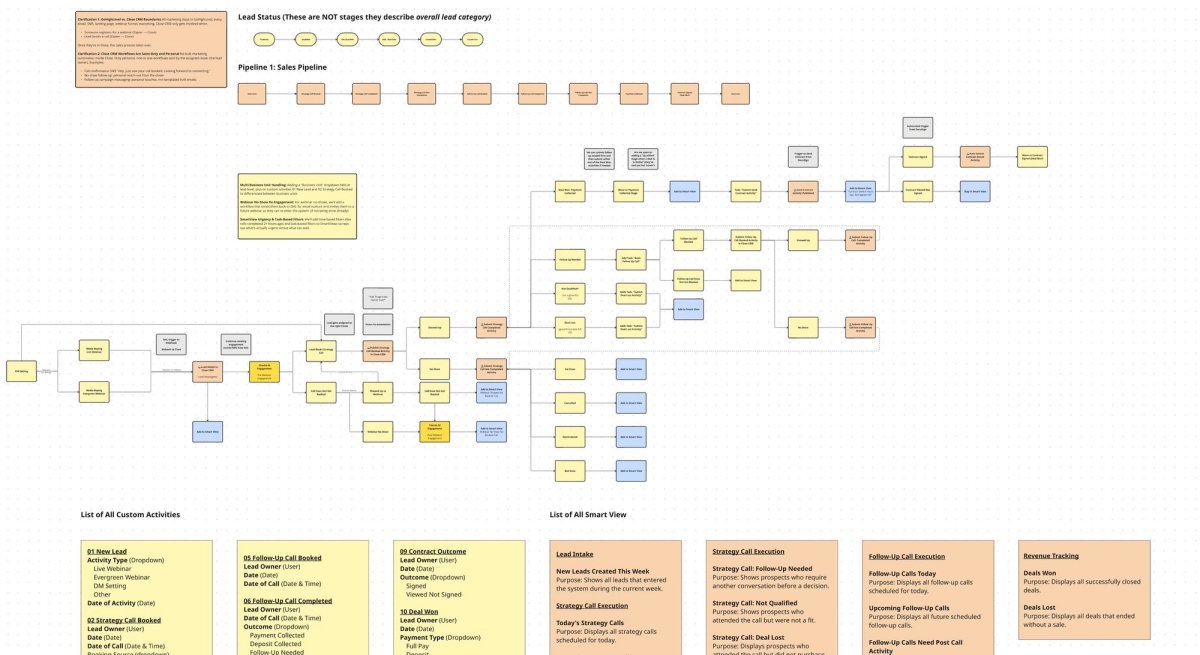
2. Design workflows so reps never have to guess what's next
My shorthand for this is the three C's: consistency, clarity, certainty. Because you can't get clarity or certainty without consistency first.
In practice: a rep should always know exactly who to call, when, how often, and for how long, without searching for leads or digging through records. Beyond the efficiency gain, it makes accountability simple. If the process is airtight and someone isn't following it, that's a training conversation, not a process problem.
3. Run a three-message pre-call sequence for every booked call
The moment someone books a call, I create a Workflow to send three short texts broken into separate sends so they read as human, not automated:
- A statement: "Just got your call booked."
- A one-word check-in: "Curious?"
- A specific, low-friction question tied to what they're interested in.
The only goal is a reply. Once they respond, the rep walks into the call having already had a real conversation instead of cold-opening the meeting. One of my clients went from a 33% show rate to 72% in 14 days after turning this on, with no added ad spend or headcount.
4. Match how many leads you assign to how many calls your team can actually make
Teams hand out lead lists without checking whether the team can physically call them at the promised cadence. If you're assigning 100 leads a week but your team can only make 80 dials a day total, hitting "call each lead three times" is impossible.
Before assigning out leads, I check how many calls each rep or setter actually makes per day, divide by the target calls-per-lead, and size the weekly lead assignment to fit, instead of assuming more leads automatically means more revenue. Fewer leads called more often often outperforms more leads called once.
5. Confirm every booked call within five minutes
I trigger a Workflow to fire off the instant a call books, with a Call step that either goes to a rep, or Close’s voice agent as the fallback. Make sure the call is delivering something useful before the meeting (a guide, early access to an asset, what to expect), not just locking down attendance.
In my experience, teams starting around a 30-50% show rate can expect at least a 20% lift from this kind of pre-call nurture.
6. Tandem dial: rep first, AI follow up, no added headcount
Build a Workflow with three Call steps: the rep dials first, and if that call doesn't connect, have your voice agent make two additional calls a few minutes apart. The net effect is that one dial from a rep turns into up to three attempts on that lead, without hiring more setters.
Pro tip: make sure to set the workflow goal as "call connected" so the sequence stops automatically the moment someone picks up.
7. Guarantee follow-up with automation
Even with a good process, follow-ups slip when they rely on a rep remembering to do them. At RevPilot, we always set up a backup automated step in Close so that if a scheduled follow-up doesn't happen manually, it fires through automation.
I pair this with a sub-five-minute speed-to-lead standard for every new lead entering the CRM, to make sure we’re connecting with as many leads as possible, as fast as possible.
Ready to start getting the most out of your leads without spending more on ads?
Get started in Close today. And if you get stuck, RevPilot is here to help.